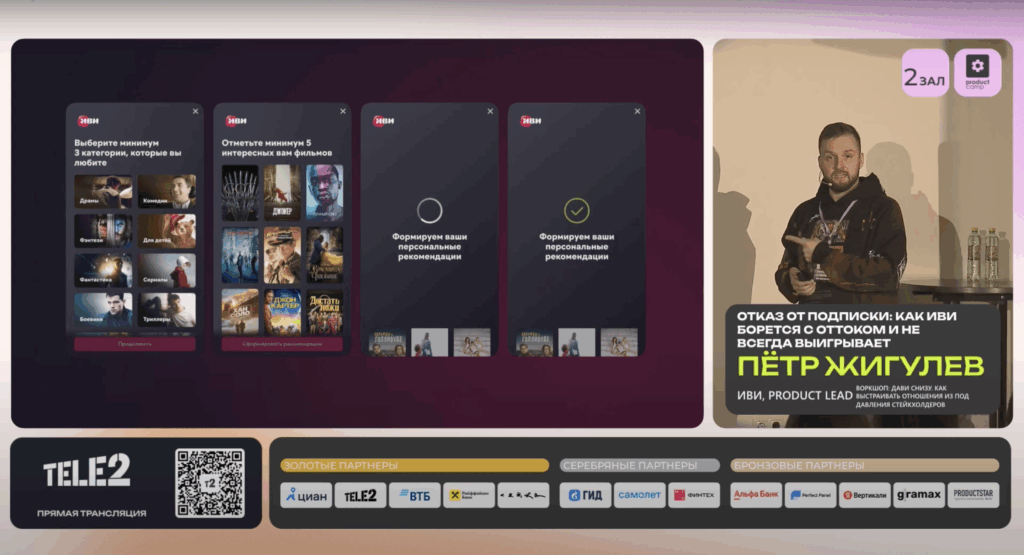
In April 2024, I had the privilege of speaking at ProductCamp Spring 2024, a vibrant conference for product managers and innovators. Held online, the event buzzed with ideas, and I was thrilled to share my insights as a Product Manager at Ivi, diving into a complex yet critical topic: subscription churn.
My talk, “Churn from Subscriptions: How to Retain Users in Your Product,” tackled the challenge of keeping users engaged in subscription-based services. The core idea? Retaining existing users is far cheaper and more effective than constantly chasing new ones. I broke down why churn happens—whether it’s poor onboarding, lack of perceived value, or friction in the user experience—and shared practical strategies to fix it. Drawing from my experience at Ivi, I highlighted data-driven tactics like personalized engagement, seamless UX, and proactive communication to boost retention.
The presentation wasn’t just about numbers; it was a call to embrace the subscription model as the future of digital products. Subscriptions build long-term relationships, create predictable revenue, and align with how users want to consume content today. By focusing on retention, companies can unlock sustainable growth. The audience connected with the message, and the Q&A session sparked lively discussions about applying these ideas across industries.
Delivering a talk on such a nuanced topic was no small feat, but the feedback was humbling. Attendees appreciated the clear, actionable insights and the passion I brought to the stage. ProductCamp 2024 was a fantastic platform to share this vision, and I left inspired, knowing the subscription economy is where the future lies.
In 2019, I had the opportunity to speak at iz.ru (Izvestia) on the topic of “Venture Infrastructure in Russia.” At this event, I shared my observations about the state and prospects of venture capital development in our country.
Early Stage and Great Prospects
I noted that the Russian venture sector is in its early stages of development. In today’s world, we have a unique opportunity to unlock the potential of innovative ideas and startups. However, a key factor in achieving success will be our ability to avoid pitfalls related to the economic and political situation in Russia.
Growth Rates of Venture Capital
According to recent data, the growth rate of venture capital in Russia stands at an impressive 30% per year. This indicates a strong interest in new ideas and startups that have the potential to disrupt the market.
Emergence of Infrastructure Players
In recent years, we have seen a rise in the number of startups and various infrastructure players, such as accelerators, venture funds, business angels, and incubators. This ecosystem is beginning to take shape and positively impacts the development of venture capital.
The Role of Government and Its Consequences
Nevertheless, I emphasized the significant role of the government in this field. Excessive interference and bureaucratic hurdles may hinder the sector’s growth and development in the future. It is crucial to find a balance that allows entrepreneurs and investors to retain their initiative.
Searching for Teams in Technical Universities
During my personal experience, I visited five technical universities in Russia to find talented teams for startup creation. This experience was disheartening, as I encountered many theorists and only a few enthusiasts willing to bring their ideas to fruition. This highlights the need for more active engagement of youth in practical activities and entrepreneurship.
In conclusion, the future of venture infrastructure in Russia appears promising but requires a careful approach to creating conditions for its growth and development.
In 2019, I spoke at the IX International Eurasian Taxi Forum (MEFT-2019) on the topic of blockchain technology applications in the transport sector, with a particular focus on the taxi industry. The foundation of my presentation was based on innovative solutions from Bitfury, a company actively developing blockchain technologies for various industries, including transportation.
My presentation demonstrated how blockchain can improve transparency, security, and efficiency in taxi operations. For example, it can simplify and automate payment processes, bookings, and the verification of driver and vehicle data. Distributed ledger technology has the potential to fundamentally change how companies interact with customers, providing more trust and control over data.
After the presentation, I discussed the potential of blockchain implementation with the executives of major taxi fleets in Russia. Key topics included the possibility of increasing transparency in financial operations, improving fleet management, and minimizing fraud through decentralized solutions.